Bitcoin is the world’s first decentralized cryptocurrency, but have you ever wondered how new bitcoins are created or how transactions are confirmed without a bank? The answer lies in a process called Bitcoin mining.
Mining is the backbone of the Bitcoin network. It secures the blockchain, verifies transactions, and introduces new bitcoins into circulation. Although the term “mining” may sound like digging for gold, Bitcoin mining involves powerful computers solving cryptographic puzzles rather than excavating minerals.
In this guide, you’ll learn exactly how Bitcoin mining works, why it’s important, and whether it’s still profitable today. I will be making references to my research in the context of my current knowledge base
What Is Bitcoin Mining?
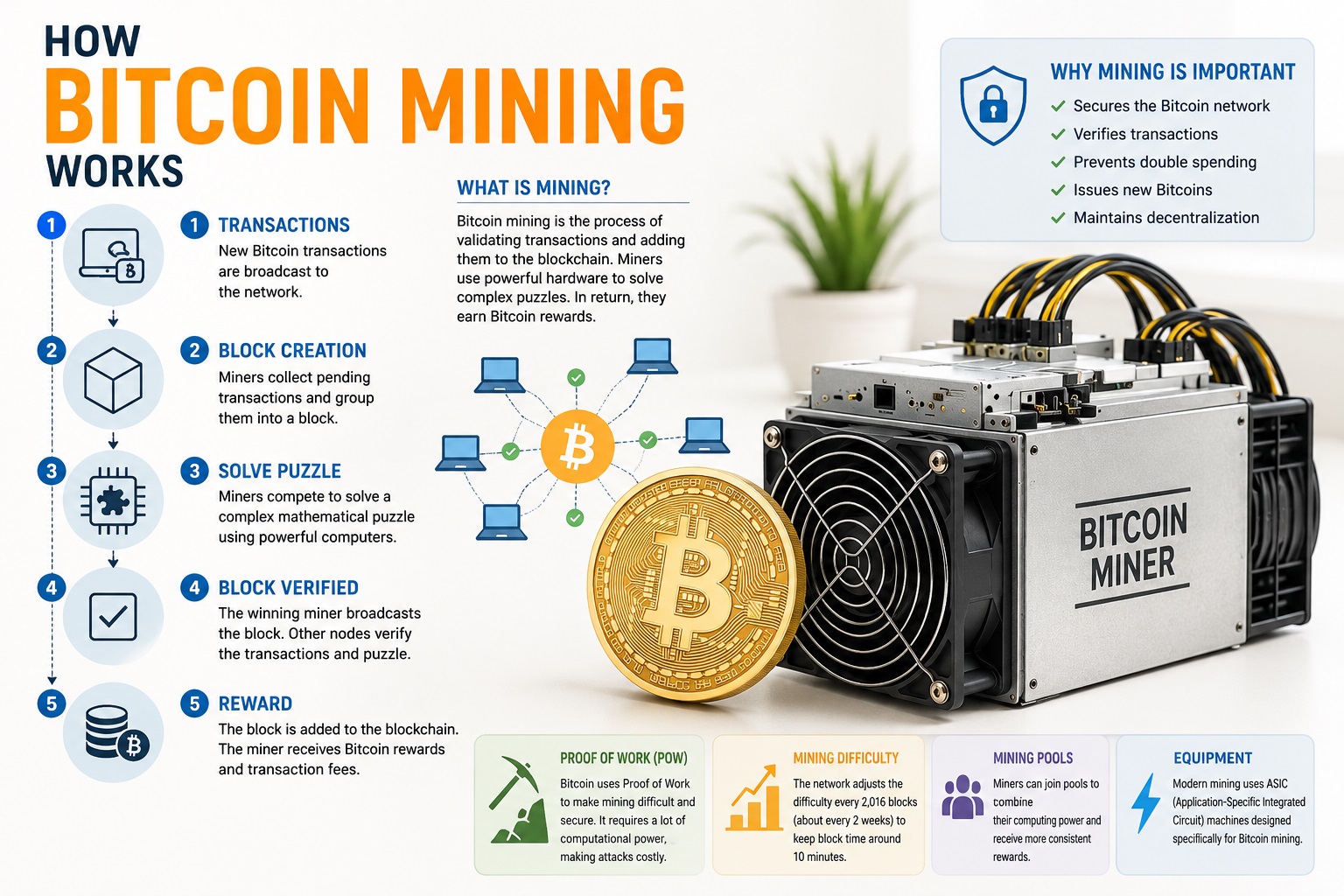
Bitcoin mining is the process through which specialized computers validate Bitcoin transactions and permanently record them on the blockchain. In return for providing this service, miners receive newly created bitcoins along with transaction fees paid by network users.
Unlike traditional banking systems that rely on central authorities, Bitcoin depends on thousands of independent miners spread across the globe. This decentralized approach helps keep the network secure and trustworthy.
Why Is Bitcoin Mining Necessary?
Mining serves several important purposes:
- Verifies that Bitcoin transactions are legitimate.
- Prevents users from spending the same bitcoin twice.
- Keeps the Bitcoin blockchain secure.
- Creates new bitcoins until the maximum supply of 21 million coins is reached.
- Maintains the decentralized nature of the Bitcoin network.
Without miners, Bitcoin would not function as a secure peer-to-peer payment system.
How Bitcoin Mining Works
Step 1: Users Send Bitcoin Transactions
Whenever someone sends Bitcoin, the transaction is broadcast to thousands of computers connected to the network.
These transactions remain unconfirmed until miners verify them.
Step 2: Transactions Are Grouped into a Block
Mining computers collect hundreds or even thousands of pending transactions and bundle them into a candidate block.
Before adding the block to the blockchain, every transaction must pass a series of validation checks.
Step 3: Miners Compete to Solve a Cryptographic Puzzle
Each miner tries to find a unique number called a nonce.
This nonce is combined with the block’s data and processed through Bitcoin’s SHA-256 hashing algorithm.
The goal is to generate a hash that falls below the network’s current target value.
Because there is no shortcut, miners must perform trillions of calculations every second until one finds the correct solution.
Step 4: The Winning Miner Broadcasts the Block
When a miner discovers a valid hash, the completed block is shared with the rest of the Bitcoin network.
Other nodes independently verify every transaction and confirm that the solution satisfies Bitcoin’s consensus rules.
Step 5: The Block Is Added to the Blockchain
Once verified, the new block becomes part of the permanent blockchain.
The miner receives the block reward and transaction fees, while the process begins again for the next block.
On average, a new Bitcoin block is added approximately every 10 minutes. (Investopedia)
What Is Proof of Work?
Bitcoin uses a consensus mechanism known as Proof of Work (PoW).
Proof of Work requires miners to perform massive amounts of computational work before earning the right to add a new block.
This mechanism makes Bitcoin highly secure because altering the blockchain would require enormous computing power and electricity, making attacks extremely expensive.
What Is Hashing?
Hashing is the process of converting data into a fixed-length string of characters using a cryptographic algorithm.
Bitcoin uses the SHA-256 hashing algorithm.
Even a tiny change in the input data produces a completely different hash, making the blockchain tamper-resistant.
Mining Difficulty
As more miners join the network, mining becomes more competitive.
Bitcoin automatically adjusts its mining difficulty every 2,016 blocks (roughly every two weeks) to ensure that new blocks continue to be mined at an average rate of one every 10 minutes. (Investopedia)
Bitcoin Mining Hardware
Mining has evolved significantly over the years.
CPU Mining: In Bitcoin’s early days, ordinary computers could mine BTC.
GPU Mining: Graphics cards later replaced CPUs because they offered much higher processing power.
FPGA Mining: These programmable chips improved efficiency but were eventually overtaken.
ASIC Mining: Today, almost all Bitcoin mining is performed using Application-Specific Integrated Circuit (ASIC) machines, which are purpose-built for mining and deliver vastly superior performance. (Investopedia)
Solo Mining vs. Mining Pools
There are two main ways to mine Bitcoin.
Solo Mining
A miner works independently and keeps the full reward if successful. However, the chances of finding a block alone are extremely small.
Mining Pools
Multiple miners combine their computing power and share rewards according to each participant’s contribution. Today, mining pools dominate the Bitcoin mining industry because they provide more consistent payouts. (Ledger)
Is Bitcoin Mining Profitable?
Mining profitability depends on several factors:
- Cost of electricity
- Price of Bitcoin
- Mining hardware efficiency
- Mining difficulty
- Cooling and maintenance expenses
- Pool fees
In regions with expensive electricity, mining may not be profitable. Large commercial mining farms often locate in areas with lower energy costs to improve profitability. (Webopedia)
Advantages of Bitcoin Mining
- Secures the Bitcoin network
- Verifies transactions without a central authority
- Generates new bitcoins
- Supports decentralization
- Rewards miners for contributing computing power
Disadvantages of Bitcoin Mining
- High electricity consumption
- Expensive ASIC equipment
- Increasing mining difficulty
- Significant competition
- Environmental concerns in areas relying on fossil fuels
The Future of Bitcoin Mining
As Bitcoin adoption grows, mining is expected to become even more competitive. Many mining companies are investing in renewable energy, improved cooling technologies, and more efficient ASIC hardware to reduce operating costs and environmental impact.
Additionally, the Bitcoin block reward is reduced by half approximately every four years in an event known as the Bitcoin Halving. This mechanism slows the creation of new bitcoins and reinforces Bitcoin’s fixed supply of 21 million coins. (Investopedia)
Conclusion
Bitcoin mining is far more than simply creating new coins. It is the process that keeps the Bitcoin network secure, validates transactions, prevents fraud, and maintains the integrity of the blockchain. Although mining has evolved from a hobby into a highly specialized industry requiring significant investment, it remains one of the most important components of the Bitcoin ecosystem.
Whether you’re a cryptocurrency enthusiast, investor, or aspiring miner, understanding how Bitcoin mining works provides valuable insight into why Bitcoin has remained one of the most secure and resilient digital assets ever created.