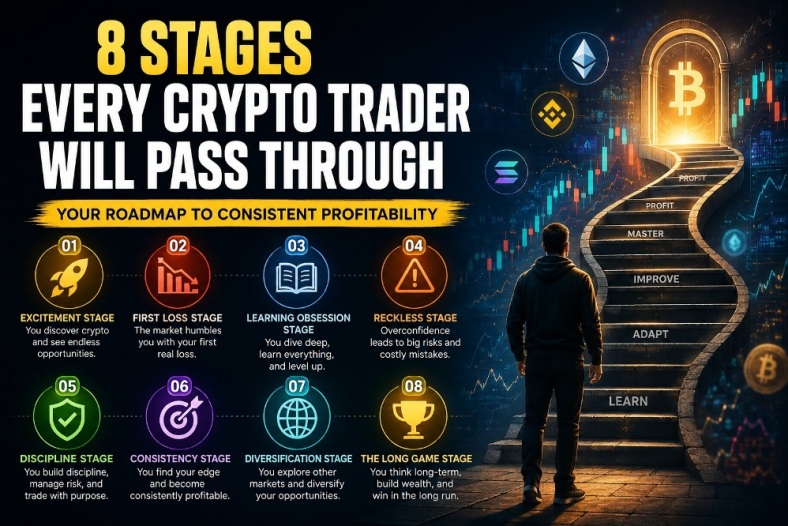
The 8 Stages Every Crypto Trader Must Pass to Become Profitable is more than just another trading guide. It’s a realistic roadmap of how successful traders develop over time. Every profitable crypto trader has a story. While their strategies, trading styles, and preferred digital assets may differ, nearly all of them follow a remarkably similar journey. They begin with excitement, experience painful losses, learn difficult lessons, develop discipline, and eventually become consistently profitable.
The difference between traders who achieve long-term success and those who quit isn’t usually intelligence, luck, or having insider information. More often, it’s their ability to stay disciplined, manage risk effectively, control their emotions, and continue learning from every mistake.
If you’re new to cryptocurrency trading, understanding these eight stages can help you avoid costly beginner mistakes and accelerate your learning curve. If you’ve already spent some time in the market, you’ll likely recognize your own experiences and gain valuable insight into what comes next.
This comprehensive guide explores the eight stages that nearly every crypto trader experiences, explaining the mindset, challenges, and lessons at each phase. More importantly, it shows you how to progress from being an emotional beginner to becoming a disciplined trader who focuses on long-term, sustainable profitability rather than short-term speculation.
Stage 1: The Excitement Phase
Every Trader Starts Here
Nearly everyone enters the cryptocurrency market with a dream of making money quickly.
Some discover Bitcoin through social media, while others hear about it from friends, influencers, or online communities. Stories of investors turning small amounts into life-changing wealth create excitement and curiosity.
At this stage, most beginners know very little about:
- Blockchain technology
- Market cycles
- Technical analysis
- Risk management
- Portfolio allocation
Instead, they focus almost entirely on one thing:
Profit.
The market looks simple. Prices rise rapidly, success stories dominate social media, and it appears as though everyone is making money.
Common Behaviors During This Stage
New traders often:
- Buy cryptocurrencies based on hype.
- Follow recommendations from Telegram or WhatsApp groups.
- Invest because a coin is “trending.”
- Purchase meme coins hoping for huge gains.
- Believe every investment can produce 10x or even 100x returns.
Many also imagine achieving financial freedom within months.
While optimism isn’t a bad thing, unrealistic expectations can become dangerous when they replace proper education.
The Hidden Risk
The excitement stage creates emotional decisions.
Instead of asking:
“Is this a good investment?”
Most beginners ask:
“How much money can I make?”
This mindset encourages impulsive buying without understanding market risks.
Eventually, reality catches up.
Markets don’t rise forever.
That leads directly to the next stage.
Stage 2: Your First Major Loss
Reality Arrives
Sooner or later, every trader experiences a painful loss.
Perhaps you bought near the top of a market rally.
Maybe you invested in a cryptocurrency that never recovered.
Or perhaps fear caused you to sell just before prices rebounded.
Whatever the reason, your portfolio suddenly turns red.
For many beginners, this is their first real encounter with market volatility.
The Emotional Rollercoaster
Large losses trigger powerful emotions.
Many traders experience:
- Fear
- Anger
- Regret
- Confusion
- Self-doubt
Questions begin to surface:
- Is crypto a scam?
- Did I make a terrible mistake?
- Will my investment ever recover?
- Should I quit trading altogether?
These emotions are completely normal.
In fact, almost every experienced trader has gone through them.
The Most Important Decision
This stage often determines a trader’s future.
You generally have two choices.
Option 1: Walk Away
Some investors decide cryptocurrency isn’t for them.
They exit the market after suffering losses and only return during the next bull market—often repeating the same mistakes.
This cycle leads many people to buy high, sell low, and lose money repeatedly.
Option 2: Learn From the Experience
Successful traders choose a different path.
Instead of blaming the market, they ask better questions:
- Why did this trade fail?
- What could I have done differently?
- How can I reduce future losses?
- What skills do I need to develop?
This shift in mindset marks the beginning of genuine growth.
Losses stop being viewed as failures and become valuable lessons.
Lessons From Stage Two
Every professional trader has lost money.
The goal isn’t to avoid losses completely—that’s impossible.
The real objective is to learn from mistakes, improve your decision-making, and ensure that one bad trade doesn’t define your trading career.
Those who embrace this lesson continue progressing.
Those who don’t often leave the market before reaching their full potential.
Stage 3: The Learning Obsession
From Curiosity to Commitment
After experiencing a painful loss, many traders make a critical decision: instead of giving up, they decide to learn. This marks the beginning of the learning obsession stage.
At this point, crypto trading is no longer just a hobby. It becomes a serious pursuit.
You begin consuming educational content every day. You watch YouTube tutorials, read articles, join Telegram and Discord communities, follow experienced traders on X (formerly Twitter), and perhaps even purchase one or more trading courses.
This stage is exciting because your understanding of the market starts to improve. Concepts that once seemed confusing gradually begin to make sense.
Building Your Trading Knowledge
As your education grows, you’re introduced to essential trading concepts, including:
- Candlestick chart patterns
- Support and resistance levels
- Trend analysis
- Moving averages
- Relative Strength Index (RSI)
- MACD (Moving Average Convergence Divergence)
- Volume analysis
- Risk-to-reward ratios
- Market psychology
For the first time, charts begin to tell a story instead of looking like random lines moving up and down.
You also learn that successful trading isn’t about luck. It requires preparation, discipline, and a repeatable strategy.
The Trap of Information Overload
While continuous learning is valuable, many traders fall into another common trap—they believe that more knowledge automatically leads to more profits.
They constantly search for:
- A “perfect” indicator
- A secret strategy
- A guaranteed entry signal
- The next trading system that never loses
This mindset often results in analysis paralysis.
Instead of mastering one proven approach, traders jump endlessly between strategies, believing the next one will solve all their problems.
In reality, profitable trading comes from executing one well-tested system consistently—not collecting dozens of strategies.
Confidence Begins to Grow
After weeks or months of studying, many traders experience their first successful trades.
Naturally, confidence increases.
They begin thinking:
- “I’m finally understanding the market.”
- “I’ve figured trading out.”
- “I know how price moves now.”
Confidence itself isn’t dangerous.
Overconfidence is.
And that’s exactly where many traders stumble next.
Stage 4: Overconfidence and Reckless Trading
When Early Success Becomes Dangerous
After gaining knowledge and experiencing several winning trades, many traders start believing they can predict every market movement.
This is one of the most expensive stages in a trader’s journey.
Confidence turns into arrogance.
Patience disappears.
Risk management becomes an afterthought.
Instead of respecting the market, traders begin trying to outsmart it.
Warning Signs of Overconfidence
During this stage, traders often:
- Increase their position sizes dramatically.
- Use excessive leverage.
- Ignore their trading plans.
- Chase trades out of fear of missing out (FOMO).
- Enter positions without proper confirmation.
- Trade too frequently.
These behaviors rarely end well.
A few lucky wins can create the illusion of skill, but markets eventually expose poor discipline.
The Risk of High Leverage
One of the biggest mistakes at this stage is abusing leverage.
Leverage allows traders to control larger positions with relatively little capital. While it can amplify profits, it also magnifies losses.
A small price movement against an over-leveraged position can result in significant losses or even the liquidation of an entire account.
For beginners especially, using high leverage without a solid risk management plan is one of the fastest ways to lose trading capital.
Ignoring Risk Management
Overconfident traders often convince themselves that the market will eventually move in their favor.
As a result, they may:
- Remove their stop-loss orders.
- Move stop-loss levels farther away to avoid being stopped out.
- Add more money to losing positions without a clear plan.
- Hold losing trades for too long instead of accepting manageable losses.
These decisions are driven by emotion rather than strategy.
Successful traders understand that protecting capital is more important than trying to prove a trade is right.
The Costly Wake-Up Call
Eventually, one trade goes badly wrong.
It might erase weeks or months of profits.
In severe cases, it wipes out an entire trading account.
The financial damage is painful.
The emotional impact can be even greater.
Many traders begin questioning their abilities and wonder whether they are suited for trading at all.
Although this experience is difficult, it often becomes the turning point that separates hobbyists from professionals.
Two Choices—Again
Just as in Stage 2, traders face another important decision.
Option 1: Quit
Some decide they’ve had enough.
The emotional stress and financial losses become overwhelming, and they leave the market believing trading is impossible.
Option 2: Accept Responsibility and Improve
Others take a more productive approach.
Instead of blaming the market, they review their mistakes.
They ask questions such as:
- Did I risk too much?
- Was this trade part of my strategy?
- Did emotions influence my decision?
- How can I improve my discipline?
This honest self-assessment lays the foundation for long-term success.
Key Lessons From Stages Three and Four
The transition from learning to overconfidence is one of the most dangerous periods in a trader’s development.
Knowledge alone is not enough.
Profitable trading requires:
- A tested trading strategy
- Consistent execution
- Strong emotional control
- Strict risk management
- Patience during both winning and losing periods
Many traders believe success comes from finding the perfect strategy.
In reality, success comes from consistently following a good strategy while managing risk effectively.
By recognizing the warning signs of overconfidence early, traders can avoid costly mistakes and prepare for the next phase of growth—developing the discipline required to achieve consistent profitability.
Stage 5: The Discipline Stage
Where Real Traders Are Made
After suffering the consequences of emotional trading and excessive risk-taking, many traders undergo a significant mindset shift. They stop chasing quick profits and begin focusing on protecting their capital.
This stage marks the transition from gambling to professional trading.
Rather than trying to double an account overnight, disciplined traders understand that consistent, smaller gains accumulated over time can lead to long-term success.
Risk Management Becomes the Priority
One of the defining characteristics of disciplined traders is that they think about risk before reward.
Instead of asking, “How much can I make?”, they ask:
- How much am I willing to lose if this trade fails?
- Does this trade meet my strategy’s criteria?
- Is the potential reward worth the risk?
This shift dramatically changes how trades are selected.
Disciplined traders commonly:
- Risk only a small percentage of their account per trade.
- Always use stop-loss orders.
- Avoid revenge trading after losses.
- Trade only when their setup is confirmed.
- Accept that missing a trade is better than forcing one.
They recognize that preserving capital is essential because without capital, there are no future opportunities.
The Value of a Trading Journal
Another habit developed during this stage is maintaining a trading journal.
Rather than relying on memory, disciplined traders document every trade, including:
- Entry price
- Exit price
- Reason for entering
- Market conditions
- Risk-to-reward ratio
- Emotional state during the trade
- Lessons learned
Over time, this journal becomes an invaluable resource. It highlights recurring mistakes, reveals successful patterns, and provides objective feedback that supports continuous improvement.
Learning Patience
Patience becomes one of the trader’s greatest strengths.
Instead of feeling the need to be in the market every day, disciplined traders understand that not trading is sometimes the best trading decision.
They wait for high-probability opportunities rather than chasing every market movement.
This patience reduces unnecessary losses and improves overall performance.
Stage 6: The Consistency Stage
Where Few Traders Arrive
Many traders never reach this stage because they quit during earlier setbacks.
Those who do arrive here have developed something more valuable than a profitable strategy—they have built consistent habits.
Consistency isn’t about winning every trade.
It’s about executing the same proven process repeatedly, regardless of recent wins or losses.
Trusting Your Trading System
By now, successful traders have tested and refined a strategy that suits their personality and risk tolerance.
Instead of constantly switching systems after a losing week, they trust the probabilities.
They understand that:
- Every strategy experiences losing trades.
- Short-term results don’t define long-term success.
- Consistency produces better outcomes than constantly searching for a “perfect” strategy.
Backtesting, journaling, and real trading experience have given them confidence based on evidence rather than emotion.
Emotional Stability
One of the clearest signs of consistency is emotional balance.
Winning trades no longer create overconfidence.
Losing trades no longer cause panic.
Professional traders accept both as natural parts of the trading process.
They understand that success is measured over hundreds of trades—not just one.
Quality Over Quantity
Interestingly, many consistently profitable traders execute fewer trades than beginners.
Rather than chasing action, they focus on:
- High-quality setups
- Favorable risk-to-reward opportunities
- Clear market structure
- Strong confirmations
They know that more trades do not necessarily mean more profits.
In many cases, trading less results in better performance because it eliminates impulsive decisions.
Stage 7: Diversification Across Financial Markets
Looking Beyond Cryptocurrency
As traders become more experienced, they begin to recognize that cryptocurrency is only one part of the global financial system.
Financial markets offer opportunities across multiple asset classes, including:
- Foreign Exchange (Forex)
- Stocks
- Commodities such as gold and crude oil
- Stock indices
- Bonds
- Exchange-Traded Funds (ETFs)
Diversification reduces dependence on a single market.
When cryptocurrency enters a prolonged period of low volatility or decline, traders with broader market knowledge can continue finding opportunities elsewhere.
Why Diversification Matters
Diversification offers several advantages:
- Reduces concentration risk.
- Provides opportunities in different market conditions.
- Expands trading experience.
- Improves understanding of global macroeconomic events.
For example:
Periods of rising inflation may benefit commodities like gold.
Changes in central bank interest rates often create opportunities in the Forex market.
Strong corporate earnings can drive stock market rallies.
Understanding these relationships allows traders to adapt rather than remain dependent on one asset class.
Stage 8: The Long Game
The Mindset That Separates Professionals
The final stage isn’t about finding a magical indicator or secret strategy.
It’s about developing a completely different perspective on trading.
Instead of focusing on today’s profit, experienced traders think about where they want to be five or ten years from now.
Their objective shifts from getting rich quickly to building wealth consistently.
Trading Becomes a Business
Professional traders begin treating trading like any successful business.
They:
- Follow written trading plans.
- Manage risk carefully.
- Review performance regularly.
- Continue learning.
- Protect their capital above everything else.
They understand that success is earned through discipline, repetition, and continuous improvement.
Your Relationship With Money Changes
Perhaps the biggest transformation occurs in how traders view money.
Beginners often dream of turning a small trading account into a fortune within weeks.
Experienced traders know this expectation is unrealistic and often dangerous.
Instead, they focus on:
- Sustainable growth
- Consistent returns
- Controlled risk
- Long-term capital preservation
This patient approach significantly increases the likelihood of lasting success.
Common Mistakes to Avoid
No matter which stage you’re currently experiencing, avoiding these common mistakes can accelerate your progress:
- Trading without a written plan.
- Risking too much on a single trade.
- Chasing losses through revenge trading.
- Following social media hype blindly.
- Using excessive leverage.
- Ignoring stop-loss orders.
- Switching strategies too frequently.
- Allowing emotions to dictate decisions.
- Neglecting continuous education.
Recognizing these pitfalls early can save both time and capital.
Conclusion
Every successful trader has experienced excitement, disappointment, overconfidence, and self-doubt. These experiences are not signs of failure—they are part of the learning process.
The difference between traders who eventually succeed and those who quit rarely comes down to intelligence or luck. Instead, it comes down to discipline, patience, effective risk management, and the willingness to keep improving after setbacks.
No matter where you are in your trading journey, remember that progress takes time. Focus on developing sound habits, protecting your capital, and learning from every trade.
Markets will always provide new opportunities. Your goal is to ensure you’re prepared to take advantage of them when they arise.