The foreign exchange market is driven by countless economic factors, making it essential for traders to understand the forces behind currency price movements. While many traders focus solely on analyzing individual currency pairs, experienced forex participants often monitor a broader indicator—the U.S. Dollar Index (USDX).
The USDX is one of the most valuable tools for measuring the overall strength or weakness of the U.S. dollar. Since the dollar is involved in nearly 90% of global forex transactions, understanding its direction can significantly improve trading decisions.
In this guide, you’ll learn what the U.S. Dollar Index is, how it works, why it matters, and how to use it alongside both technical and fundamental analysis to gain an advantage in the forex market.
What Is the U.S. Dollar Index (USDX)?
The U.S. Dollar Index (USDX) measures the value of the U.S. dollar relative to a basket of six major international currencies. Instead of comparing the dollar to just one currency, the index provides a broader view of the dollar’s overall performance in the global economy.
The six currencies included in the basket are:
- Euro (EUR)
- Japanese Yen (JPY)
- British Pound (GBP)
- Canadian Dollar (CAD)
- Swedish Krona (SEK)
- Swiss Franc (CHF)
Among these currencies, the euro carries the largest weighting, making movements in the EUR/USD pair particularly influential on the index.
Because these currencies represent some of the world’s largest economies, the USDX serves as a reliable benchmark for evaluating the strength of the U.S. dollar on a global scale.
Why the USDX Matters in Forex Trading
The U.S. dollar is the world’s primary reserve currency and plays a central role in international trade, commodities, and financial markets. As a result, shifts in the dollar’s value often influence nearly every major forex pair.
Rather than analyzing each USD pair individually, traders can monitor the Dollar Index to understand whether the U.S. dollar is strengthening or weakening across the market.
For example:
- A rising USDX generally signals increasing demand for the U.S. dollar.
- A falling USDX suggests broad weakness in the dollar.
This broader perspective helps traders confirm trends before entering positions in currency pairs.
Understanding How the Dollar Index Is Measured
The Dollar Index uses a base value of 100.000.
The index fluctuates above or below this level depending on changes in the dollar’s value relative to the six currencies.
For instance:
- A reading of 105.600 means the U.S. dollar has appreciated approximately 5.6% since the index’s base period.
- A reading of 92.300 indicates the dollar has weakened by about 7.7% from the base level.
Because the index is quoted to three decimal places, traders can monitor even small changes in market sentiment.
The History Behind the USDX
The Dollar Index was introduced in the early 1970s after the collapse of the Bretton Woods monetary system.
During this period, many major economies agreed to allow their currencies to float freely instead of remaining fixed against the U.S. dollar.
As exchange rates became market-driven, investors needed a benchmark to measure the overall strength of the dollar. The USDX was developed to meet that need and has remained one of the most respected indicators for currency traders ever since.
Although newer versions of the dollar index have been introduced—such as the Federal Reserve’s Trade-Weighted Dollar Index—the traditional USDX remains the preferred benchmark among most forex traders because of its widespread use and historical consistency.
Combining Technical Analysis with the USDX
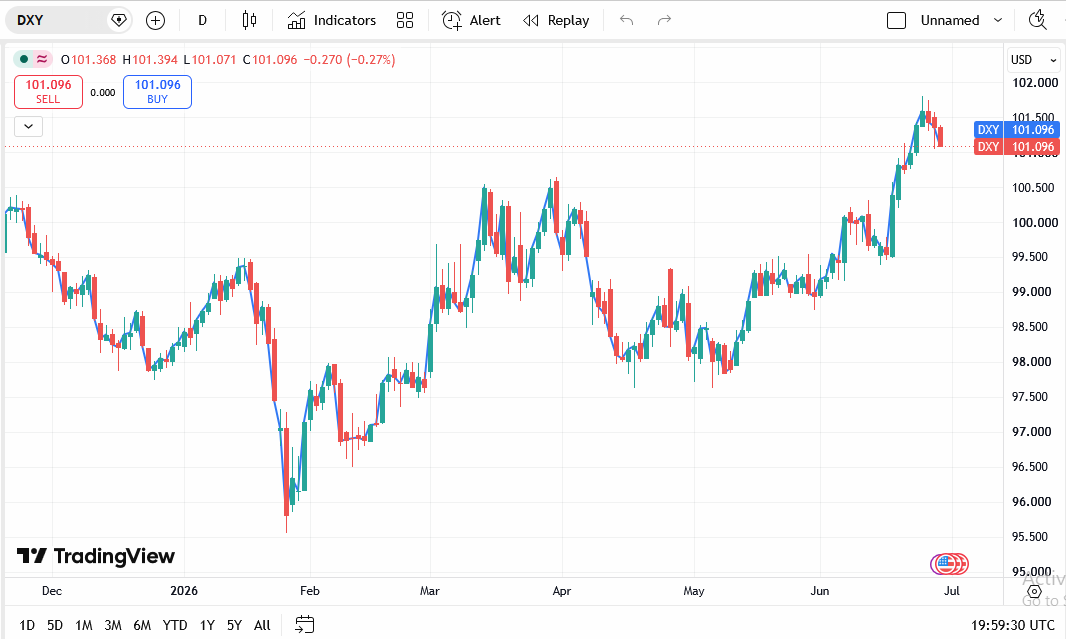
The Dollar Index is not only valuable for fundamental analysis—it can also be analyzed using traditional technical analysis techniques.
Many traders apply the same methods used on currency charts to the USDX itself.
Popular technical tools include:
Trend Analysis
Identifying higher highs and higher lows can confirm bullish momentum, while lower highs and lower lows suggest bearish conditions.
Support and Resistance
Like currency pairs, the USDX often respects important support and resistance zones. Breakouts and rejections around these levels can provide early clues about future dollar strength or weakness.
Chart Patterns
Patterns such as triangles, head-and-shoulders formations, double tops, and double bottoms frequently appear on the Dollar Index chart and can signal potential reversals or trend continuations.
Candlestick Analysis
Japanese candlestick patterns—including pin bars, engulfing candles, and dojis—can reveal changes in buying or selling pressure before major price moves occur.
Fibonacci Retracement
Retracement levels often identify potential reversal zones during trending markets, helping traders anticipate corrections in the dollar’s movement.
Using the USDX to Predict Currency Pair Movements
One of the greatest advantages of monitoring the Dollar Index is understanding its relationship with major forex pairs.
Inverse Correlation
Pairs where the U.S. dollar is the quote (counter) currency typically move in the opposite direction of the Dollar Index.
Examples include:
- EUR/USD
- GBP/USD
- AUD/USD
- NZD/USD
If the USDX begins rallying, these currency pairs often decline because the U.S. dollar is gaining strength.
Conversely, if the Dollar Index falls, these pairs frequently move higher as the dollar weakens.
Positive Correlation
Currency pairs where the U.S. dollar is the base currency usually move in the same direction as the Dollar Index.
Examples include:
- USD/JPY
- USD/CHF
- USD/CAD
When the USDX rises, these pairs often appreciate as well.
If the Dollar Index weakens, they may begin trending lower.
Understanding these relationships allows traders to confirm trade setups with greater confidence.
Don’t Forget the Position of the U.S. Dollar
One common mistake beginners make is assuming that every USD pair behaves the same way.
The key is remembering whether the U.S. dollar appears first or second in the currency pair.
For example:
EUR/USD
- Dollar is the quote currency.
- Rising USDX usually means EUR/USD falls.
GBP/USD
- Dollar is the quote currency.
- Stronger Dollar Index often leads to GBP/USD weakness.
USD/JPY
- Dollar is the base currency.
- Rising USDX often supports upward movement.
USD/CHF
- Dollar is the base currency.
- A stronger dollar typically pushes the pair higher.
Recognizing this distinction helps traders avoid costly mistakes when interpreting market signals.
Integrating Fundamental Analysis
The Dollar Index becomes even more powerful when combined with macroeconomic analysis.
Several economic factors can influence the index, including:
- Federal Reserve interest rate decisions
- Inflation data
- Employment reports
- GDP growth
- Consumer confidence
- Manufacturing activity
- Geopolitical developments
- Global risk sentiment
For example, stronger-than-expected U.S. employment figures may boost expectations of tighter monetary policy, increasing demand for the U.S. dollar and lifting the Dollar Index.
Likewise, weaker economic data or expectations of interest rate cuts can put downward pressure on the index.
Monitoring these events alongside the USDX provides traders with a more complete picture of market direction.
Final Thoughts
The U.S. Dollar Index is one of the most effective yet underutilized tools in forex trading. Instead of focusing solely on individual currency pairs, traders can use the USDX to understand the broader direction of the U.S. dollar, confirm technical setups, and strengthen fundamental analysis.
Whether you’re trading EUR/USD, GBP/USD, USD/JPY, or USD/CHF, the Dollar Index offers valuable confirmation before entering or exiting a trade.
By combining the USDX with chart analysis, support and resistance, candlestick patterns, and major economic events, traders can improve their market timing and make more informed decisions.
In today’s fast-moving forex market, understanding the strength of the world’s most traded currency isn’t just helpful—it’s an essential part of building a successful trading strategy.