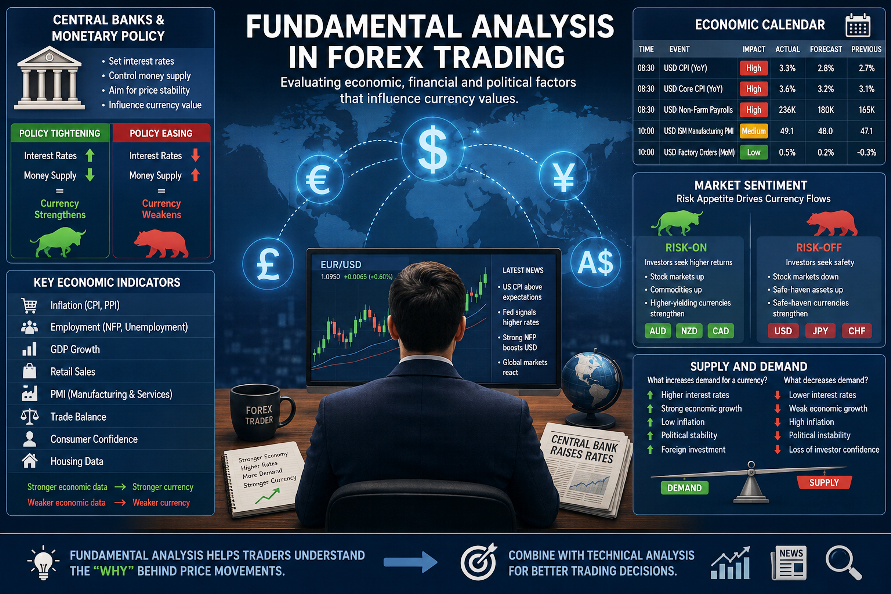
Fundamental analysis in forex trading is the process of evaluating the intrinsic value and future direction of a currency by studying economic, financial, and geopolitical factors that influence supply and demand. Unlike technical analysis, which focuses on price charts and historical patterns, fundamental analysis seeks to understand why a currency is likely to strengthen or weaken based on real-world economic conditions.
How Fundamental Analysis Works
Every currency derives its value from the strength and stability of the economy it represents. Traders who use fundamental analysis examine key economic indicators, central bank policies, and market sentiment to forecast future exchange rate movements.
The principle is simple:
- If a country’s economy is strengthening, its currency tends to appreciate.
- If economic conditions are deteriorating, its currency is more likely to depreciate.
This is because investors prefer to hold currencies that offer higher returns, stronger economic growth, and greater financial stability.
The Role of Central Banks
Central banks are the most influential institutions in the forex market. Their primary responsibility is maintaining price stability and supporting sustainable economic growth.
They achieve this through monetary policy, mainly by controlling:
- Interest rates
- Money supply
When Interest Rates Rise
A central bank may increase interest rates when inflation becomes too high.
Higher interest rates generally:
- Increase returns on savings and investments.
- Attract foreign capital.
- Reduce money circulating in the economy.
- Strengthen the country’s currency.
When Interest Rates Fall
A central bank may reduce interest rates when economic growth slows.
Lower interest rates generally:
- Encourage borrowing and spending.
- Increase money circulating in the economy.
- Reduce investment returns.
- Weaken the country’s currency.
For example, if a central bank unexpectedly raises interest rates while another country’s central bank keeps rates unchanged, the first country’s currency often appreciates because investors seek higher yields.
Why Economic Data Matters
Central banks base their monetary policy decisions on economic conditions. Therefore, traders closely monitor major economic reports to anticipate future policy changes.
Some of the most important economic indicators include:
- Inflation (CPI and PPI): Measures changes in prices. High inflation often leads to higher interest rates.
- Employment Data (Non-Farm Payrolls, Unemployment Rate): Indicates labor market strength.
- Gross Domestic Product (GDP): Measures overall economic growth.
- Retail Sales: Reflects consumer spending.
- Manufacturing and Services PMI: Shows business activity.
- Consumer Confidence: Measures household optimism.
- Trade Balance: Compares exports and imports.
- Housing Data: Indicates the health of the property market.
These reports help traders determine whether a central bank is likely to tighten or loosen monetary policy.
Economic Calendars
Fundamental traders rely heavily on economic calendars, which provide:
- Upcoming economic events.
- Release dates and times.
- Previous results.
- Market forecasts (consensus estimates).
- Expected market impact.
Price movements are often driven not just by the actual data, but by how it compares with market expectations.
For example:
- Expected inflation: 2.8%
- Actual inflation: 3.3%
Because inflation exceeded expectations, traders may anticipate future interest rate increases, causing the currency to strengthen.
Market Sentiment
Fundamental analysis also considers market sentiment, which reflects investors’ willingness to take risk.
Risk-On Environment
When investors are optimistic:
- Stock markets rise.
- Commodity-linked currencies often strengthen.
- Investors buy higher-yielding currencies.
Examples include:
- Australian Dollar (AUD)
- New Zealand Dollar (NZD)
Risk-Off Environment
When uncertainty increases due to wars, recessions, or financial crises:
- Investors seek safer assets.
- Safe-haven currencies tend to appreciate.
Common safe-haven currencies include:
- US Dollar (USD)
- Japanese Yen (JPY)
- Swiss Franc (CHF)
Market sentiment can be assessed by monitoring:
- Global stock indices
- Bond markets
- Commodity prices
- Market volatility
Supply and Demand
Ultimately, currency prices are determined by supply and demand.
A currency’s demand increases when:
- Interest rates rise.
- Economic growth is strong.
- Inflation is under control.
- Foreign investment increases.
- Political conditions are stable.
Demand falls when:
- Interest rates decline.
- Economic growth weakens.
- Inflation becomes excessive.
- Political instability increases.
- Investors lose confidence.
Fundamental vs. Technical Analysis
| Fundamental Analysis | Technical Analysis |
| Studies economic conditions | Studies price charts |
| Focuses on the causes of price movement | Focuses on price patterns |
| Best for medium- to long-term trends | Best for short- to medium-term trading |
| Uses economic reports and news | Uses indicators and chart patterns |
| Predicts future value based on economic strength | Predicts future price based on historical behavior |
Many professional traders combine both approaches—using fundamental analysis to identify the overall market direction and technical analysis to determine precise entry and exit points.
Conclusion
Fundamental analysis is an essential approach for understanding the forces that drive the forex market. By analyzing central bank decisions, interest rates, inflation, employment, GDP, and overall market sentiment, traders can anticipate shifts in currency values before they become fully reflected in price charts.
Rather than relying solely on historical price movements, fundamental analysis provides insight into the underlying economic reasons behind market trends. When combined with sound risk management and technical analysis, it becomes a powerful tool for making informed trading decisions and improving long-term trading performance.