The European cryptocurrency market is entering a new era of regulation, and one of the world’s largest crypto exchanges, Binance, is among the companies adjusting to the new legal landscape.
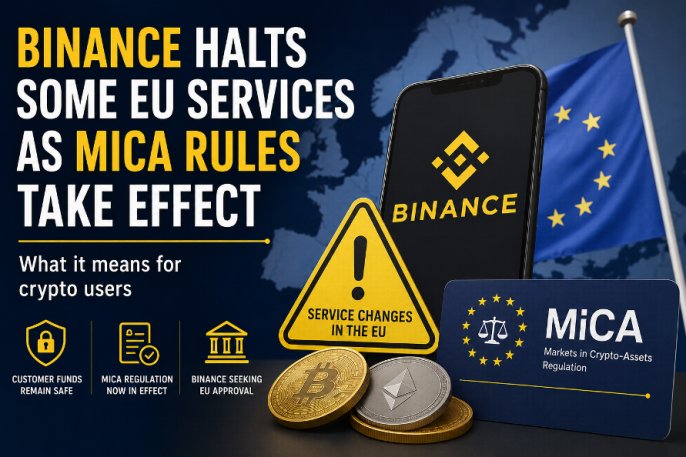
Binance has announced that it will stop serving certain customers in the European Union following the end of the transitional period under the European Union’s Markets in Crypto-Assets (MiCA) regulation. The move reflects the growing pressure on cryptocurrency companies to comply with Europe’s unified regulatory framework before continuing operations across the region.
Although the announcement has raised concerns among users, Binance has reassured customers that their digital assets remain safe and fully accessible. The exchange emphasized that it is not requesting users to withdraw their funds before the implementation date and is actively working toward obtaining the necessary regulatory approvals to resume full services within the EU.
Why Binance Is Suspending Some EU Services
The decision is primarily linked to the implementation of MiCA, the European Union’s landmark cryptocurrency regulation designed to create a single legal framework for digital asset businesses operating across all member states.
Under MiCA, cryptocurrency exchanges, wallet providers, stablecoin issuers, and other crypto service providers must obtain authorization from a national regulator before offering services throughout the European Economic Area.
Binance stated that it has not yet secured the required authorization needed to continue operating under the new framework. As a result, the company has begun notifying customers in several countries, including:
- France
- Poland
- Italy
- Spain
- Other affected EU member states
The exchange explained that the changes are part of its effort to remain compliant with European regulations while continuing discussions with regulators.
What Is MiCA?
The Markets in Crypto-Assets (MiCA) regulation is the European Union’s first comprehensive law governing cryptocurrencies and digital assets.
Its primary objectives include:
- Protecting investors and consumers.
- Increasing transparency within the crypto industry.
- Preventing fraud and market manipulation.
- Creating consistent rules across all EU countries.
- Encouraging responsible innovation in blockchain technology.
Before MiCA, crypto companies often had to comply with different regulations in each European country. The new framework allows firms that receive authorization in one EU member state to “passport” their services across the entire European Union.
This creates a more unified crypto market while raising compliance standards for exchanges.
Why France Could Become Binance’s Next Regulatory Hub
Industry observers expect France to become Binance’s primary licensing destination within Europe.
France has emerged as one of Europe’s leading jurisdictions for cryptocurrency innovation due to its relatively mature regulatory environment and active digital asset ecosystem.
If Binance successfully secures authorization through French regulators, the exchange could potentially regain access to customers throughout the EU under MiCA’s passporting system.
This would eliminate the need for separate licensing in every individual member state.
Customers’ Funds Remain Safe
One of the biggest concerns surrounding regulatory announcements is whether users need to move their cryptocurrency.
Binance has made it clear that:
- Customer assets remain secure.
- Funds are still accessible.
- Users are not required to withdraw their cryptocurrencies before the transition deadline.
- The exchange continues to safeguard customer holdings while regulatory discussions continue.
This reassurance aims to reduce unnecessary panic withdrawals and maintain confidence among users.
Growing Regulatory Pressure on Crypto Exchanges
Binance’s situation highlights the broader transformation taking place across the cryptocurrency industry.
Around the world, governments are introducing stricter regulations that require exchanges to strengthen:
- Anti-money laundering (AML) controls.
- Know Your Customer (KYC) procedures.
- Consumer protection measures.
- Risk management systems.
- Operational transparency.
Many crypto firms are now investing heavily in compliance departments and legal teams to meet evolving regulatory standards.
While these regulations may increase operational costs, they are also expected to improve trust in the digital asset industry over the long term.
What This Means for European Crypto Investors
For most users, the immediate impact depends on their country of residence and the specific services they use on Binance.
Customers should:
- Monitor official Binance announcements.
- Stay informed about any account-specific notifications.
- Avoid reacting to rumors on social media.
- Ensure their identity verification information is up to date.
- Continue following local regulatory guidance.
Users should also remember that regulatory changes do not necessarily indicate financial instability within an exchange. In many cases, they simply reflect compliance with evolving legal requirements.
A New Chapter for Europe’s Crypto Industry
The implementation of MiCA marks one of the most significant regulatory developments in the history of the European cryptocurrency market.
While Binance’s temporary service adjustments may create short-term uncertainty, the company has reiterated its commitment to obtaining the necessary approvals and restoring full operations across the European Union.
If successful, Binance could eventually operate under a single MiCA license, allowing it to serve millions of European customers through one harmonized regulatory framework.
For the broader crypto industry, MiCA represents a major step toward greater institutional acceptance, stronger consumer protection, and clearer operating rules. Exchanges that successfully adapt to these requirements are likely to be better positioned for long-term growth as digital assets become increasingly integrated into the global financial system.