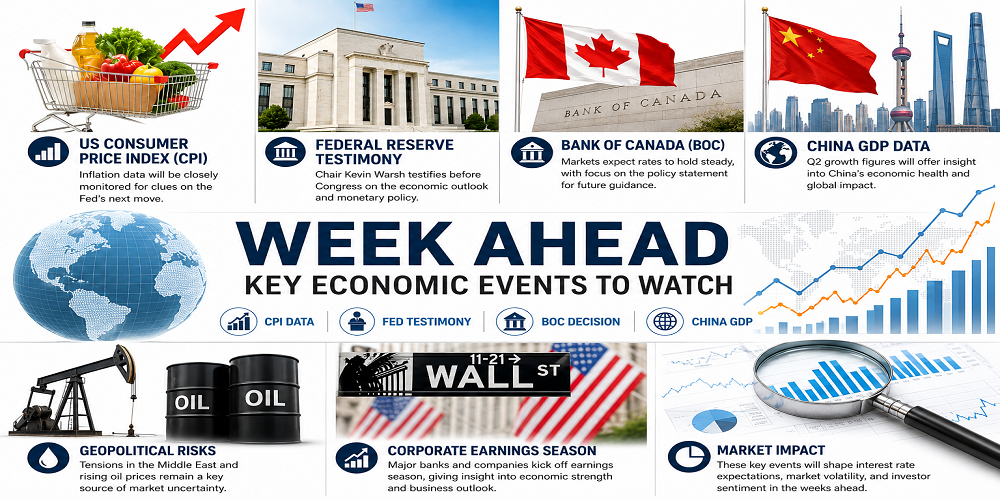
The upcoming week is expected to be one of the most closely watched periods for global financial markets. Investors, economists, and policymakers will pay close attention to a series of high-impact economic events that could influence currencies, stock markets, bonds, and commodities worldwide.
Among the key events are the release of the United States Consumer Price Index (CPI), Federal Reserve Chair Kevin Warsh’s testimony before Congress, the Bank of Canada’s monetary policy announcement, and China’s second-quarter Gross Domestic Product (GDP) report. Together, these developments will provide fresh insights into the health of the global economy and the future direction of monetary policy.
US Inflation Report Takes Center Stage
One of the most anticipated events this week is the release of the US Consumer Price Index (CPI), the country’s primary measure of inflation. Inflation reflects the rate at which the prices of goods and services increase over time and is one of the most important indicators used by central banks when making interest rate decisions.
Economists expect inflation to moderate slightly compared to the previous month, largely due to lower fuel prices. However, inflation is still projected to remain above the Federal Reserve’s long-term target of 2%, indicating that price pressures continue to persist across parts of the economy.
Why the CPI Matters
The CPI report has the potential to move financial markets because it directly influences expectations regarding future Federal Reserve policy.
If inflation is higher than expected:
- The Federal Reserve may keep interest rates elevated for a longer period.
- The US dollar could strengthen against other major currencies.
- Treasury bond yields may rise.
- Stock markets could experience increased volatility as investors reassess borrowing costs.
On the other hand, if inflation comes in lower than expected:
- Expectations for future interest rate cuts may increase.
- The US dollar could weaken.
- Equity markets may react positively as investors anticipate a more accommodative monetary policy.
Because of its influence on interest rate expectations, the CPI report is considered one of the most important monthly economic releases.
Federal Reserve Chair Kevin Warsh’s Testimony
Another major event will be Federal Reserve Chair Kevin Warsh’s testimony before the US Congress. During the hearing, lawmakers are expected to question him about inflation, economic growth, employment conditions, financial stability, and the outlook for interest rates.
Investors will carefully analyze both his prepared remarks and responses to questions for clues about the Federal Reserve’s future policy direction. Even subtle changes in tone or language can significantly influence market sentiment and expectations.
Other Important US Economic Reports
In addition to the inflation report, several other economic indicators will be released throughout the week, including:
- Producer Price Index (PPI), which measures inflation at the wholesale level.
- Retail Sales, providing insight into consumer spending.
- Consumer Sentiment, reflecting household confidence in the economy.
- Manufacturing surveys, offering a snapshot of business activity.
Together, these reports will help investors determine whether the US economy remains resilient or is beginning to lose momentum.
Bank of Canada Policy Decision
Attention will also shift to Canada as the Bank of Canada announces its latest monetary policy decision.
Most analysts expect the central bank to leave interest rates unchanged. However, investors will focus closely on the accompanying policy statement for signals about future interest rate adjustments and the central bank’s assessment of inflation and economic growth.
Any unexpected change in tone could affect the Canadian dollar and broader North American financial markets.
China’s Economic Growth in Focus
China will release its second-quarter GDP figures alongside several other important economic indicators.
As the world’s second-largest economy, China’s economic performance has a significant impact on global trade, commodity demand, manufacturing activity, and investor confidence.
Market participants expect economic growth to slow modestly due to weaker domestic demand and softer investment activity. However, exports continue to provide support to the economy.
A stronger-than-expected GDP report could improve confidence in the global economic outlook, while weaker results may increase concerns about slowing worldwide growth.
Geopolitical Risks Remain a Key Market Driver
Economic data will not be the only factor influencing financial markets this week. Ongoing geopolitical tensions, particularly in the Middle East, continue to pose risks to global energy supplies and investor confidence.
Any disruption to oil production or transportation could push crude oil prices higher, contributing to inflationary pressures and complicating the task of central banks seeking to stabilize prices.
As a result, geopolitical developments may amplify market reactions to economic data releases throughout the week.
Corporate Earnings Season Begins
The week also marks the beginning of a new corporate earnings season in the United States.
Several major financial institutions are expected to report their quarterly financial results. Investors will examine these reports for indications of consumer spending trends, business investment, loan demand, corporate profitability, and the overall strength of the economy.
Strong earnings could support stock market gains, while disappointing results may raise concerns about slowing economic activity.
Educational Insight
This week’s economic calendar highlights how multiple factors work together to shape financial markets. Inflation data, central bank communication, economic growth reports, corporate earnings, and geopolitical events all influence investor decisions.
Rather than focusing on a single event, experienced investors evaluate how these developments interact before making investment decisions. Understanding the relationship between inflation, interest rates, economic growth, and monetary policy is essential for anyone seeking to understand how global financial markets operate.
Conclusion
The combination of the US inflation report, Federal Reserve Chair Kevin Warsh’s congressional testimony, the Bank of Canada’s policy decision, and China’s economic growth figures makes this one of the most significant weeks on the global economic calendar.
The outcomes of these events are expected to influence expectations for interest rates, currency movements, stock market performance, and investor sentiment. For students, traders, and investors alike, monitoring these developments provides valuable insight into the forces shaping the global economy and financial markets.