Don’t Just Invest – Invest with a Purpose
Have you ever wondered why some people make steady returns while others build life-changing wealth? The answer is not always about how much money they invest it is about where they invest and why.
Understanding Investment Asset Classes in Nigeria: How to Choose the Right Investment for Your Financial Goals is more than just a guide—it is a roadmap to making smarter financial decisions in an increasingly complex investment landscape. Many Nigerians jump into investments simply because they hear that “everyone is making money” from a particular asset. One year it is cryptocurrency, another year it is stocks, and the next it is real estate. Unfortunately, investing without understanding the purpose of each asset class often leads to costly mistakes and disappointing outcomes.
The truth is simple: every investment has a role to play. Some are designed to preserve your wealth, some help it grow steadily over time, while others offer the potential for extraordinary returns but come with significantly higher risks. Knowing the difference can help you build a diversified portfolio, manage risk effectively, and make informed financial decisions regardless of your income level.
Whether you are a student, salary earner, entrepreneur, retiree, or business owner in Nigeria, understanding how different asset classes work can help you achieve your short-term and long-term financial goals. This guide explores the major investment asset classes, explains the different types of loans and debt instruments, and provides practical examples that are relevant to the Nigerian economy.
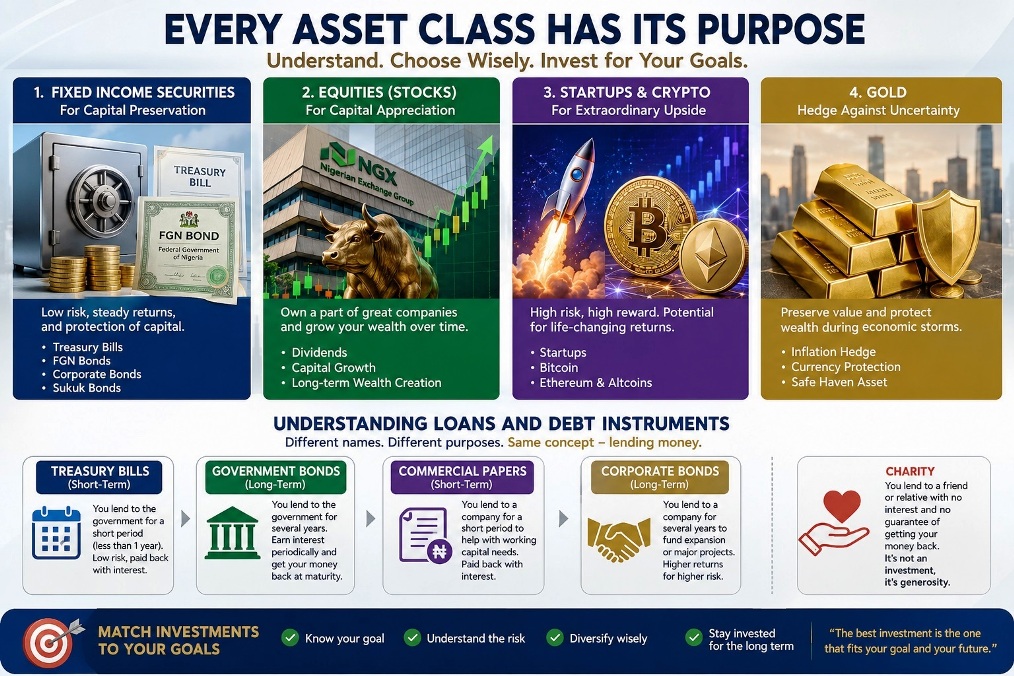
Every Asset Class Has a Purpose
Successful investors rarely put all their money into one investment. Instead, they spread their investments across different asset classes based on their financial goals and risk tolerance.
Let’s explore each one.
- Fixed Income Securities: For Capital Preservation
If your primary goal is to protect your capital while earning predictable returns, fixed income investments should be part of your portfolio.
Fixed income securities are investments where you lend money to a government or company in exchange for regular interest payments and the return of your principal at maturity.
Common Examples in Nigeria
- Nigerian Treasury Bills (T-Bills)
- Federal Government of Nigeria (FGN) Savings Bonds
- FGN Bonds
- Sukuk Bonds
- Corporate Bonds
These investments generally carry lower risk than stocks or cryptocurrencies.
Who Should Invest?
Fixed income investments are ideal for:
- Retirees
- Salary earners saving for future expenses
- Conservative investors
- Emergency fund preservation
Although the returns may not be spectacular, they provide stability and predictable income.
- Equities (Stocks): For Capital Appreciation
If your objective is to grow your wealth over time, investing in equities may be a better choice.
Buying shares means becoming a part-owner of a company. As the business grows, your investment can increase in value, and you may also receive dividend payments.
Nigerian Examples
Investors on the Nigerian Exchange (NGX) can buy shares of companies such as:
- GTCO
- Zenith Bank
- Airtel Africa
- Dangote Cement
- BUA Foods
- MTN Nigeria
Historically, quality stocks have outperformed inflation over long periods.
However, stock prices fluctuate daily, meaning investors should be prepared for short-term volatility.
- Startups and Cryptocurrency: For Extraordinary Upside Potential
If you’re seeking high-risk, high-reward opportunities, startups and cryptocurrencies offer some of the greatest upside potential.
Startups
Investing in startups means backing new businesses before they become successful.
Companies like Flutterwave, Paystack, and Moniepoint started as small ventures before growing into billion-dollar businesses.
Early investors in successful startups often earn exceptional returns.
However, many startups fail, making this one of the riskiest investment categories.
Cryptocurrency
Digital assets like Bitcoin, Ethereum, and Solana have created remarkable wealth for early adopters.
Some cryptocurrencies have delivered returns that traditional investments could not match over short periods.
However, crypto markets are highly volatile.
Prices can rise dramatically—but they can also fall just as quickly.
Investors should only allocate money they can afford to leave invested for the long term.
- Gold: A Safe Haven During Economic Uncertainty
Gold has been considered a store of value for thousands of years.
Whenever inflation rises, currencies weaken, or geopolitical tensions increase, many investors move part of their wealth into gold.
For Nigerians, gold can also serve as protection against:
- Inflation
- Naira depreciation
- Global financial uncertainty
Gold may not generate regular income like bonds or dividends like stocks, but it has historically preserved purchasing power over long periods.
Matching Investments to Your Financial Goals
Different goals require different investments.
If your goal is protecting your savings, fixed income securities may be appropriate.
If your goal is building wealth gradually, equities can provide long-term growth.
If you’re willing to take significant risks in pursuit of exceptional returns, startups and cryptocurrencies may deserve a small allocation.
If your concern is preserving wealth during uncertain economic conditions, gold can act as a valuable hedge.
There is no universally “best” investment. The best investment is the one that aligns with your objectives, investment horizon, and risk tolerance.
Understanding Loans and Debt Instruments
Many people hear terms like Treasury Bills, Government Bonds, and Corporate Bonds without understanding what they actually mean.
Although they all involve lending money, they differ in who receives the loan and how long the money is borrowed.
Treasury Bills (Short-Term Government Loans)
When you lend money to the Federal Government for a short period—typically less than one year—you are investing in Treasury Bills.
The government pays you back at maturity, along with your investment return.
Treasury Bills are considered among the safest investments available because they are backed by the government.
Government Bonds (Long-Term Government Loans)
When the government needs money for longer periods—often several years—it issues Government Bonds.
These usually provide periodic interest payments and return your principal when the bond matures.
Government bonds are commonly used to finance infrastructure projects, roads, schools, hospitals, and other national development initiatives.
Commercial Papers (Short-Term Corporate Loans)
Companies also borrow money from investors.
When they need funds for short-term operations such as inventory, payroll, or working capital, they issue Commercial Papers.
Investors receive interest, while companies obtain quick access to financing.
Corporate Bonds (Long-Term Corporate Loans)
When companies need financing for expansion, new factories, acquisitions, or major projects, they may issue Corporate Bonds.
These generally offer higher interest rates than government bonds because they involve greater risk.
Investors should always assess the company’s financial strength before investing.
And Then There’s “Charity”
There is one type of “loan” that does not fit into any financial category.
When you lend money to a friend or relative without charging interest, without a written agreement, and without any assurance that your money will be returned, you are often making a charitable gesture rather than an investment.
Helping loved ones is admirable, but it is wise to distinguish between money you expect to recover and money you are giving out of goodwill. Doing so can prevent misunderstandings and protect both your finances and your relationships.
Key Lessons Every Nigerian Investor Should Remember
Building wealth is not about chasing the latest investment trend. It is about understanding what each asset class is designed to achieve.
A balanced investment strategy may combine:
- Fixed income for stability and capital preservation.
- Equities for long-term growth.
- Gold for protection against inflation and economic uncertainty.
- Startups and cryptocurrencies for carefully managed high-growth opportunities.
By diversifying your investments and matching them to your financial goals, you can create a portfolio that is better positioned to withstand market changes while pursuing sustainable wealth creation.
Final Thoughts
Financial success is rarely or not the result of luck it is the product of informed decisions made consistently over time. Before investing, ask yourself a simple question: What is my goal? Once you know the answer, choosing the right asset class becomes much easier.
Remember, every asset class has its purpose. Use each one wisely, and you’ll be better equipped to protect your money, grow your wealth, and achieve your long-term financial goals. Please DYOR.